Universal accessibility: what does it really mean for your home?

We hear more and more about universal accessibility , both in public buildings and private residences. Yet, this concept is often misunderstood or reduced to a few visible modifications. Universal accessibility is not just about wheelchair users: it aims to create usable, safe, and comfortable environments for everyone , regardless of age, physical condition, or temporary situation.
In this article, we explain what universal accessibility applied to the home really means, and why it represents a wise choice, both today and for the future.
Understanding the concept of universal accessibility
Universal accessibility is based on a simple principle: designing spaces that can be used by the greatest number of people possible, without complex adaptation or excessive effort .
At home, this means:
to facilitate travel;
reduce physical obstacles;
improve security;
to promote independence in daily life.
This concept applies equally to an elderly person, a parent with a stroller, a person who is temporarily injured, or anyone wishing to move around in a more functional environment.
Universal accessibility is not reserved for situations of disability.
A common misconception is that universal accessibility is solely linked to permanent disability. In reality, we are all susceptible to experiencing reduced mobility , even temporarily.
Common examples:
an injury or convalescence;
a loss of balance related to age;
fatigue or decreased strength;
the transport of heavy or bulky objects.
An accessible home is one that can adapt to these realities without compromising safety or comfort.
The key principles of universal accessibility at home
1. Smooth and safe travel
Traffic areas must be clear, well-lit, and easy to navigate. This includes:
sufficiently wide passages;
the absence of unnecessary thresholds;
non-slip surfaces.
The goal is to reduce the risk of falls and to facilitate movement, with or without mobility aids.
2. Eliminating vertical barriers
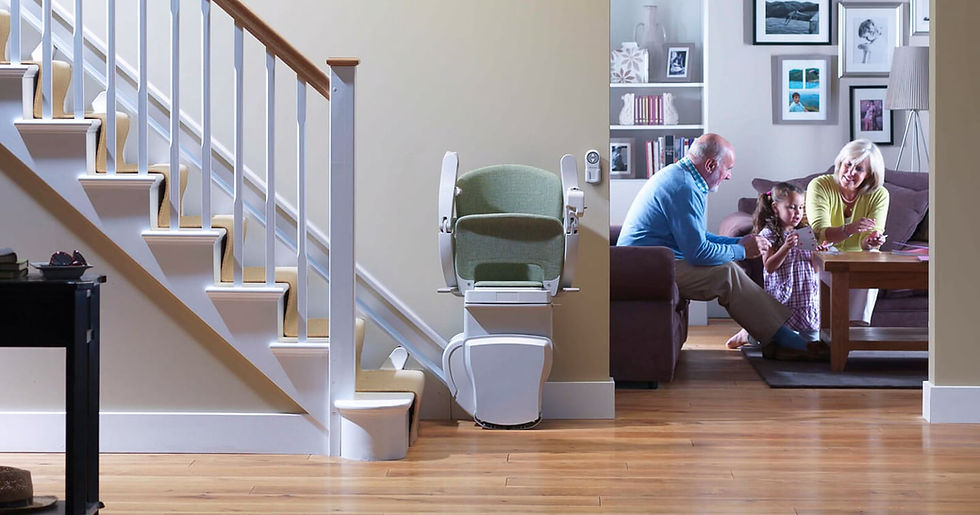
Stairs are one of the main obstacles to accessibility at home. Several solutions exist to overcome them:
Staircase seating;
lifting platforms;
residential elevators.
These devices allow the floors to be connected safely, while maintaining access to the entire home.
3. Functional and adaptable spaces
An accessible home is an adaptable home. This means that essential rooms must be usable without undue constraint:
safe and accessible bathroom;
functional kitchen;
Easy entry and exit points.
Adaptability allows us to respond to evolving needs without having to renovate repeatedly.
The importance of the bathroom in universal accessibility
The bathroom is often the most critical room in terms of safety. In a universal accessibility approach, it must offer:
non-slip surfaces;
well-positioned grab bars;
an accessible shower;
adequate lighting.
These elements help to reduce the risk of accidents while improving daily comfort.
Facilitating access from the moment you enter your home
Accessibility begins outside. An accessible home must allow for:
an unobstructed entrance;
doors that are easy to open;
a smooth flow between the outside and the inside.
Solutions such as lifting platforms or automatic door openers greatly improve autonomy and safety.
A home that's affordable today, an investment for tomorrow
Thinking about universal accessibility also means anticipating the future . Adapting your home before the needs become urgent allows you to:
to avoid hasty decisions;
to spread investments over time;
to choose sustainable and scalable solutions.
An accessible home often allows people to stay at home longer , even when their mobility changes.
Added value for the property
Contrary to some misconceptions, universal accessibility does not detract from the aesthetics or value of a house. On the contrary:
it improves overall functionality;
It broadens the pool of potential buyers;
It increases the long-term appeal of the property.
A well-designed home is one that meets the needs of a larger number of people.
Possible financial assistance
In some cases, adaptations related to universal accessibility may be eligible for financial assistance , particularly within the framework of home adaptation programs or depending on the occupant's situation.
It is important to gather information before starting work in order to maximize opportunities for financial support.
The importance of a comprehensive and professional approach
Universal accessibility is not limited to a one-off installation. It is based on a comprehensive vision of the home and lifestyle habits.
A professional assessment allows for:
to identify current obstacles;
to anticipate future needs;
to propose coherent solutions;
to ensure the safety and compliance of the facilities.
Universal accessibility applied to the home aims to create a safe, functional, and inclusive environment for everyone. It does not simply address an immediate need, but represents a true investment in quality of life, independence, and peace of mind.
An accessible home is a home that adapts to life, today as well as tomorrow.
Do you want to make your home more accessible and permanently adapted? Contact Mobilatec Elevators for a personalized assessment and to discover accessibility solutions tailored to your needs.


Comments