
Subsidies for home adaptations in Quebec: what you need to know before starting your work

Adapting a home to improve accessibility and mobility often represents a significant investment. Fortunately, in Quebec, several financial assistance programs and subsidies exist to support people with functional limitations and their families. However, these programs are sometimes unknown or misunderstood, which can lead to costly mistakes.
In this article, we review the main subsidies related to home adaptation , the general conditions of eligibility and the essential elements to know before undertaking work .
Why are there subsidies for home adaptations?
The subsidies aim to enable people with reduced mobility or loss of autonomy to remain at home for as long as possible , in a safe environment adapted to their needs.
Eligible work may include, depending on the situation:
the installation of lifting platforms;
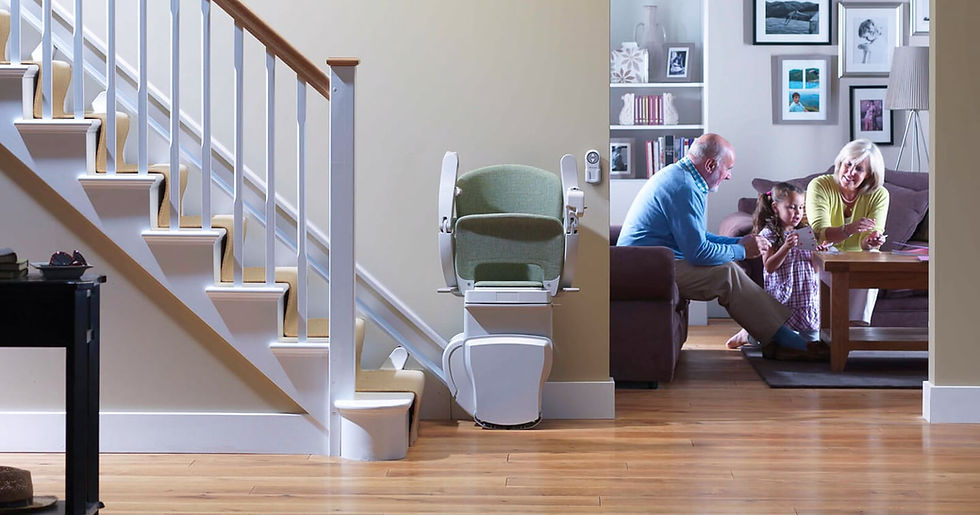
the installation of stair seats;
the installation of patient lifts;
the addition of automatic door openers;
various adaptations aimed at safety and accessibility.
These financial aids aim to reduce physical barriers while promoting the autonomy and dignity of the occupants.
The Home Adaptation Program (HAP)
The Home Adaptation Program (PAD) is one of the main financial levers for accessibility work in Quebec. It is intended for people with a significant and persistent disability or functional limitation.
Objective of the PAD
The PAD aims to adapt a home to allow a person to:
to enter and leave his residence;
to move around inside safely;
to use the essential rooms of the dwelling.
General conditions of eligibility
Without going into administrative details, the PAD is generally based on:
a professional assessment of needs (often by an occupational therapist);
a recognized functional limitation;
a permanent adaptation project;
prior approval before work begins.
Following the steps is fundamental: work undertaken without prior authorization may not be eligible for financial assistance .
Financial assistance related to the SAAQ
When a functional limitation results from a road accident , certain home adaptations may be covered by the SAAQ.
In this context, the adaptations aim to enable the injured person to:
to move around more easily in his home;
to access the entrances and floors;
to regain maximum autonomy in daily life.
Each situation is assessed individually, and adaptations generally require approval before implementation . Financial support may cover all or part of eligible costs, depending on professional recommendations and the established rehabilitation plan.
CNESST-related measures
In the case of a work-related injury , certain home adaptations can be integrated into a social rehabilitation plan supported by the CNESST.
Unlike a single grant program, the CNESST often intervenes in the form of:
refunds;
allowances;
support measures tailored to the worker's situation.
These measures aim to help the individual regain functional autonomy compatible with their condition after a workplace accident. Here again, prior approval and adherence to the process are essential.
Common mistakes to avoid
When it comes to grants, certain errors can jeopardize eligibility:
❌ Starting work too early
One of the most frequent mistakes is to start work before receiving official authorization.
❌ Not having needs assessed
A professional assessment often forms the basis of the case. It helps to justify the requested adaptations.
❌ Choosing an unsuitable solution
An unsuitable or non-compliant installation may be refused or partially covered.
❌ Neglecting support
The process can be complex. Having good support helps avoid oversights and unpleasant surprises.
Why support is essential
Grant programs are governed by specific rules. Good support allows for:
to understand the eligibility criteria;
to plan the work in the correct order;
to choose compliant and appropriate solutions;
to optimize the chances of obtaining financial assistance.
Professional support also facilitates coordination between the various stakeholders involved in the project.
Grants and planning: a key step in the project
Financial aid should not be considered a mere bonus, but a central element of planning . By taking subsidies into account from the outset, it is often possible to:
to opt for a more sustainable solution;
to improve overall home security;
to reduce the financial impact of the project.
Home adaptation subsidies in Quebec can be invaluable in improving accessibility and mobility at home. Whether it's the Home Adaptation Program, a situation related to a road accident, or a workplace injury, each case is unique and requires a rigorous approach.
Before undertaking any work, it is essential to gather information, have your needs assessed, and plan the project taking into account available assistance programs.
Are you considering home adaptation work? Contact Mobilatec Elevators for a personalized assessment and to better understand the subsidies and financial aid that may apply to your situation.


Comments